
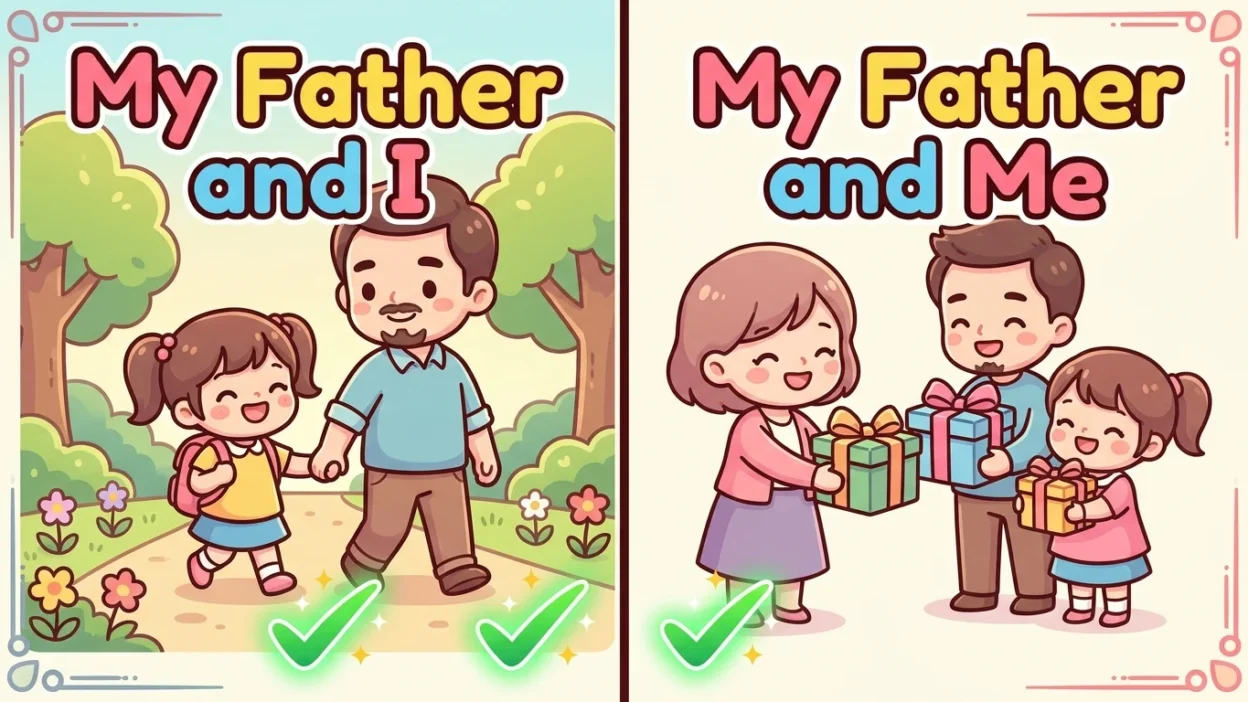
Many English learners feel confused between “my father and I” and “my father and me.” Since both phrases sound common in conversation, choosing the correct one can feel difficult. However, grammar rules make the difference very simple.
So, if you want natural and grammatically correct English, you need to know when to use each phrase. In this guide, you’ll learn the difference, examples, and easy tricks to avoid mistakes confidently.
Quick Answer
✨ Here’s the simple rule:
- ✅ My father and I = subject of the sentence
- ✅ My father and me = object of the sentence
👉 Easy trick:
- Remove “my father and” from the sentence
🌟 Examples:
- My father and I went shopping. ✔
- She invited my father and me. ✔
When to Use “My Father and I”
First of all, “my father and I” works as the subject of a sentence. Therefore, both people perform the action.
Common Uses:
- Beginning of sentences
- Performing actions
- Subjects of verbs
Examples:
- My father and I watched a movie.
- My father and I love cricket.
- My father and I traveled together.
👉 So, if both people do the action, use “I.”
When to Use “My Father and Me”
On the other hand, “my father and me” works as the object of a sentence. Therefore, another person acts on both people.
Common Uses:
- Receiving actions
- After prepositions
- Objects of verbs
Examples:
- She called my father and me.
- The teacher spoke to my father and me.
- They invited my father and me to dinner.
👉 So, if the action happens to both people, use “me.”
Easy Grammar Trick
Whenever you feel unsure, remove “my father and” from the sentence.
Example 1:
- My father and I went home.
👉 Remove extra words: - I went home. ✔
- Me went home. ❌
Example 2:
- She invited my father and me.
👉 Remove extra words: - She invited me. ✔
- She invited I. ❌
👉 Because of this trick, you can choose correctly every time.
Key Differences Between “My Father and I” and “My Father and Me”
| Phrase | Grammar Role | Example |
|---|---|---|
| My father and I | Subject | My father and I played football |
| My father and me | Object | She helped my father and me |
Common Mistakes to Avoid
Even though the rule is simple, many people still make mistakes. So, let’s fix them:
❌ Incorrect:
- Me and my father went shopping.
✔ Better: My father and I went shopping.
❌ Incorrect:
- The gift was for my father and I.
✔ Correct: The gift was for my father and me.
👉 So, always check whether the phrase acts as subject or object.
American vs British English
Interestingly, both American and British English follow the same grammar rule. However, casual speech sometimes breaks the rule informally.
Real-Life Examples
In Daily Conversation:
- My father and I enjoy traveling.
- They helped my father and me.
In School or Work:
- My father and I attended the meeting.
- The manager spoke with my father and me.
Why This Matters
Although this looks like a small grammar detail, the correct pronoun improves clarity and fluency. When you choose correctly:
- You sound more natural
- You improve grammar accuracy
- You avoid awkward mistakes
As a result, your English becomes smoother and more confident.
FAQs
Which is correct: my father and I or my father and me?
Both are correct, but they are used in different grammar situations.
When should I use my father and I?
Use it when the phrase acts as the subject.
When should I use my father and me?
Use it when the phrase acts as the object.
Is me and my father correct?
It sounds informal and less grammatically correct in standard English.
What is the easiest way to remember this?
Remove “my father and” to test the sentence.
Is this rule the same in US and UK English?
Yes, both follow the same grammar rule.
Final Thoughts
Now you clearly understand the difference between “my father and I” and “my father and me.”
While one works as a subject, the other works as an object. Because of this simple grammar rule, you can avoid a very common English mistake easily.
As you continue practicing, you will naturally choose the correct phrase without hesitation. So, instead of guessing, you will speak and write clearly every time.